
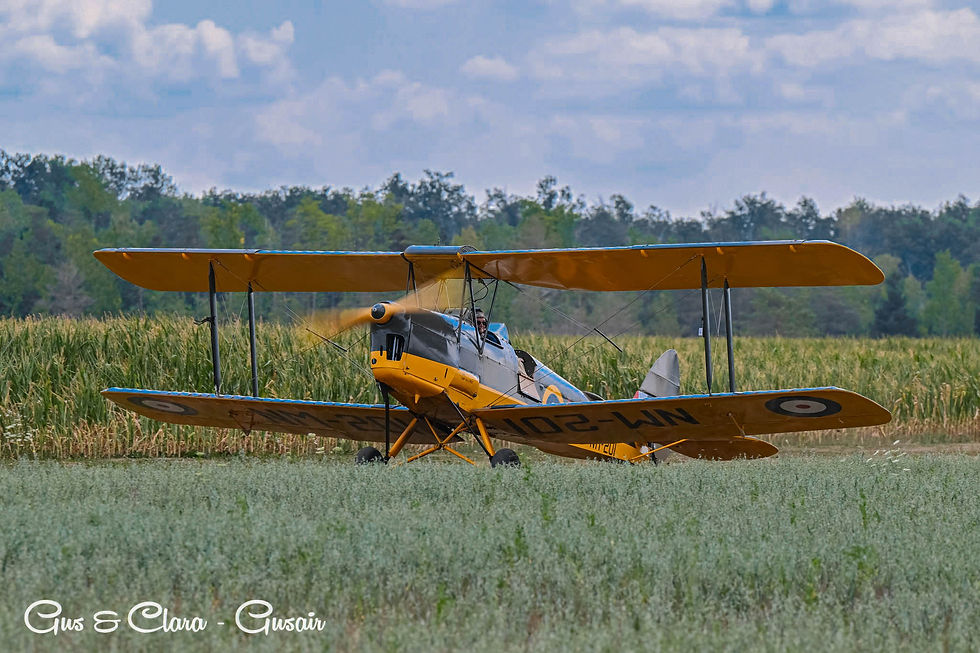
DH82A Tiger Moth
The Tiger Moth holds a special place in Canadian aviation history for it was used as the primary trainer for the majority of the nearly fifty thousand pilots trained in Canada under the British Commonwealth Training Plan in WWII.
It was produced in Canada, Australia, New Zealand, Portugal, Norway and Sweden as well as England.
Specifications
-
Number Built: 8389
-
Year Produced: 1943
-
Manufacturer: Morris Motors, under license of de Havilland
-
Engine: Gipsy Major 1C, 145 hp
Performance
-
Maximum Speed: 180 mph
-
Cruising Speed: 90 mph
-
Service Ceiling: 14,200 ft
-
Fuel Capacity: 19 Imp Gal
History of C-GSTP - NM201
Built in 1943 by Morris Motors at Cowley, Oxford, this Tiger Moth began its life in the thick of the Second World War, when Britain’s need for dependable primary trainers was at its peak. Taken on strength in 1944 as NM201 at RAF Wroughton, it never entered frontline service and instead was placed into storage, a quiet fate shared by many late-war Tiger Moths as the RAF shifted to more advanced training aircraft. In 1946, as Europe rebuilt, the aircraft found new purpose with the French Air Force, joining the large fleet of ex-RAF trainers France relied on during its postwar recovery. It transitioned to civilian life in 1951 under the French registration F-BGCP, beginning a long and colourful civil career across several countries. In 1969 it crossed the Channel to Ireland as EI-AUB, before making a much larger leap in 1975 when it was exported to Texas and registered as N82JS. The Tiger Moth came to Canada in 1981, settling in Edmonton, and in 1987 it found its permanent home with the Edenvale Classic Aircraft Foundation, where it has been flown regularly ever since. Today, it stands as a living piece of aviation history, its fabric wings carrying the stories of wartime Britain, postwar France, and decades of devoted caretakers who ensured its survival.
Origin of the Moth
The origin of the aircraft can be traced back to the 1925 DH60 Moth. Powered initially by the 60hp Cirrus engine, the aircraft became a mainstay of British flying clubs. A developed version, the DH60T Moth Trainer was offered to the Royal Air Force as a primary trainer but they showed only lukewarm interest.
The designers then went back to the drawing board to make some required improvements. The main change was the need to improve access to the front cockpit, which was restricted by the presence of the aircraft’s fuel tank directly above the front cockpit and the rear support struts for the upper wing. The solution adopted was to move the upper wing forward but sweep the wings back to maintain the centre of lift.

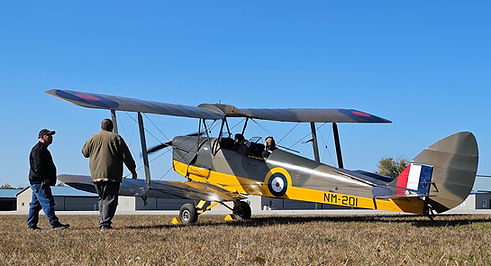
The other significant change was to use the Gipsy engine which was inverted relative to the Cirrus-that is the cylinders were now on the bottom of the engine instead of on top. This change had two effects; the propeller was now higher off the ground giving better clearance and, the view over the nose was improved. The modified aircraft now designated DH82 Tiger Moth first flew on October 26, 1931.
These improvements warranted a Royal Air Force contract for 35 aircraft and other orders soon followed. In the summer of 1932 a slightly improved engine, the Gipsy Major I was fitted to the aircraft, this, together with some minor changes to the airframe resulted in the major production version, the DH82a Tiger Moth. This version was the last version built in England.
Canadian Built Tiger Moths
In 1936 a contract was awarded for 25 aircraft to be built for the RCAF in Toronto at de Havillands’ Downsview plant, subject to some modifications to suit Canadian conditions. An enclosed, heated cockpit, metal struts for the wings instead of wood and other smaller modifications were made at the request of the RCAF.
During production more changes were made including the addition of brakes and a tailwheel to take advantage of the hard surface runways then coming into use in Canada. These changes justified a new designation of DH82c and over 1500 were built and used to equip training squadrons across Canada.
